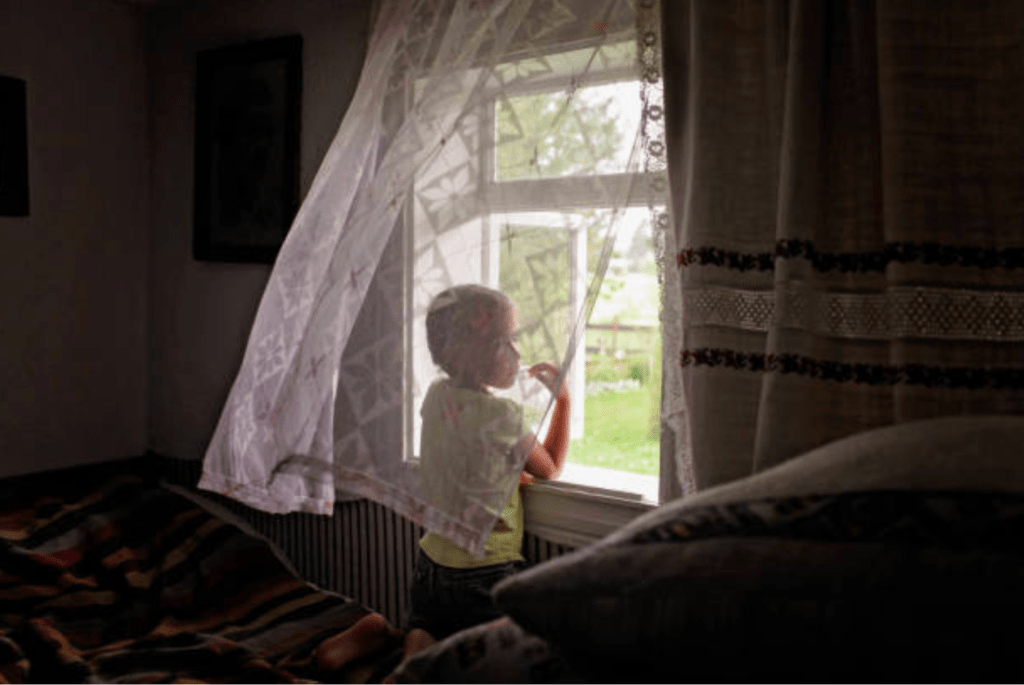
A toddler, cheek pressed to the carpet, sticks her head under the bed, and in blind optimism, knows no fear as she enters the monster’s lair.
I wake in the middle of the night and in the haze of exhaustion I see the monster from my past, the one I use to check for every night under my bed. I’d tug up the blue checkered bed skirt and shove my head under. My eyes that had been squeezed shut would flash open, look left, look right—no monsters. And then with a deep breath and the comfort that comes from the process of reassuring misguided notions, I would relax. But last night in the haze of exhaustion, I thought I saw it again. It stood, right there, at the closet, with the curtains billowing from the ventilation’s draft, I swear to you! I blinked and like all good monsters, it was gone. In that moment, though, I had felt it. A corrupted nostalgia rose within me and from it, the wisps of what I thought had been unseated: anger.
A few years ago, I finally outgrew the temper tantrums of my terrible twos. I think it took a bit longer than my parents had expected, but anger like that, it was a release, addictive I think. I was prone to bouts of anger, yes, but as a whole, all my emotions would be rated at a high valence. I was full; of laughter; of softness; altogether, of life. The tears always fell freely, because after all, they were free. To grow older though, is to stick a price on everything. I was aloft in my dream world, with no anticipation of the end, freely feeling, hoping, wishing. I was dancing when the music stopped (1).
I remember the first time it happened. The injustice of it. Treat others as you want to be treated, but I would never speak to anyone like that. Of course I fought it. I was the angry child, remember? The one who could never calm down. Then I learned what it is to fight a bully of that size. To bow is a different kind of bending that we women learn; a repeated self-sacrifice as you shed more of yourself. With each layer, you weaken, and yet no metamorphosis occurs. The tyrant looms, unphased. To fight when you will never, never win is a–and I can almost feel it again, the anger, and then I breathe, and I remember. I can fight but I won’t win; I will get nothing except more pain. I resort to the burden of suppression.
I cross the street and bump shoulders with a woman screaming into her phone. I should be mad, I should be seething like her, but as I see the eyes avert and the borderline disgust etched onto the faces of passersby, I remember: no one likes a mad woman (2). Instead, I contort, and in turn, so does the anger. To anger is to exhaust ourselves; instead, we de-identify ourselves and resolve that we should have known better.
Nowadays, I don’t check for the monster under my bed. Instead I ask questions, assuage, please, serve; I play the game. The train slows and I wait for them to get off first. You speak of feminine rage but by the time I was old enough to be called a woman, the thing called anger? I didn’t remember it anymore. Isn’t that embarrassing?
I can’t stand myself. I see right through me. I see right through me (3). The children who never knew how to control themselves become the masters of control. We take our shovels and we bury until the motion of tugging the soil from the earth becomes so familiar that we dig the graves unconsciously; so easily, we could do it in our sleep. The undertaker has arrived, the burden of suppression has begun. To seethe becomes a privilege, and forgetting becomes the learned behavior that promises survival.
When the monster came again, I had forgotten, forgotten what it was like to be angry—but it was nothing more than a badly suppressed memory. We always remember. Now I wish for that monster to appear again. To wake again and see him, because I know now that the price for memories that are swallowed again and again is joy in a diluted form, a morphed state. To see the monster was an expectation to feel again. Anger, a coin that, imprinted on its other side, was joy. As a child, I so desperately guarded against the monster, but now I want to find him, to drag him out, to ignite the spark. The kid who could never calm down—I miss that girl. We are taught how to not get angry and when we succeed, we call it maturity.
Last night I stuck my head under the bed again, looked left, looked right—and I saw him. His scarlet eyes piercing the darkness; right there, curled up against the wall, lay the monster of my past, that old demon, anger. I said hello.
__________
(1) From Taylor Swift’s “Happiness,” a line that suggests that pain is often exacerbated by its jarring nature. We don’t expect it. We’re still dancing—and then the music stops.
(2) Taylor recounts in “Mad Woman” that the “other woman” should be mad, too, but she rarely is.
(3) In “The Archer” Taylor reveals her anxiety that her facade isn’t as foolproof as she might think.
Artist Statement: Hearing the topic of “feminine rage,” my mind immediately thought of Taylor Swift’s songs. As a passive listener, I had always perceived her as the angry woman, but listening again to a collection of her songs, what I hear is not anger, but sadness; a rage that has been quieted, contorted. With age came the thing called maturity, which is to say, we as women learn to stifle our rage.
 words by ava
Leave a comment